Speak up for non-human animals as if your own life were on the line.

Why have many vegans become lax when the victims are non-human animals? If you were a prosecutor in a courtroom, you’d never:
- meet a rapist or murderer where they are
- suggest baby steps to stop rape or murder
- offer welfare to victims
- pander to the perpetrator
- frame the perpetrator’s comfort as a priority
- view the end of the injustice in a gradual way
Yet many vegans do exactly this when the victims are non‑human animals. They soften, apologize, cushion, and “meet people where they are” – as if moral clarity were optional – just to be liked because they think that if the perpetrators like them, they might miraculously go vegan. Nothing could be further from the truth. It is the biggest misconception. The moment you pander and become desperate, non‑vegans lose respect for you, take you less seriously, and deflect responsibility even more. When someone says they’ll “never go vegan,” it’s usually guilt speaking through denial – an admission buried under guilt suppression. Don’t believe it. And when you soften even more, they mock you, call you extreme – that’s gaslighting. Drop your “they will never go vegan” anxiety; it only fuels a vicious cycle.
This cycle always follows the same pattern:
- Guilt → internal discomfort
- Discomfort → denial
- Denial → defensiveness
- Defensiveness → mockery or ridicule
- Mockery → vegan softness
- Softness → loss of respect
- Loss of respect → more denial and more violence
And the victims pay the price every single time.
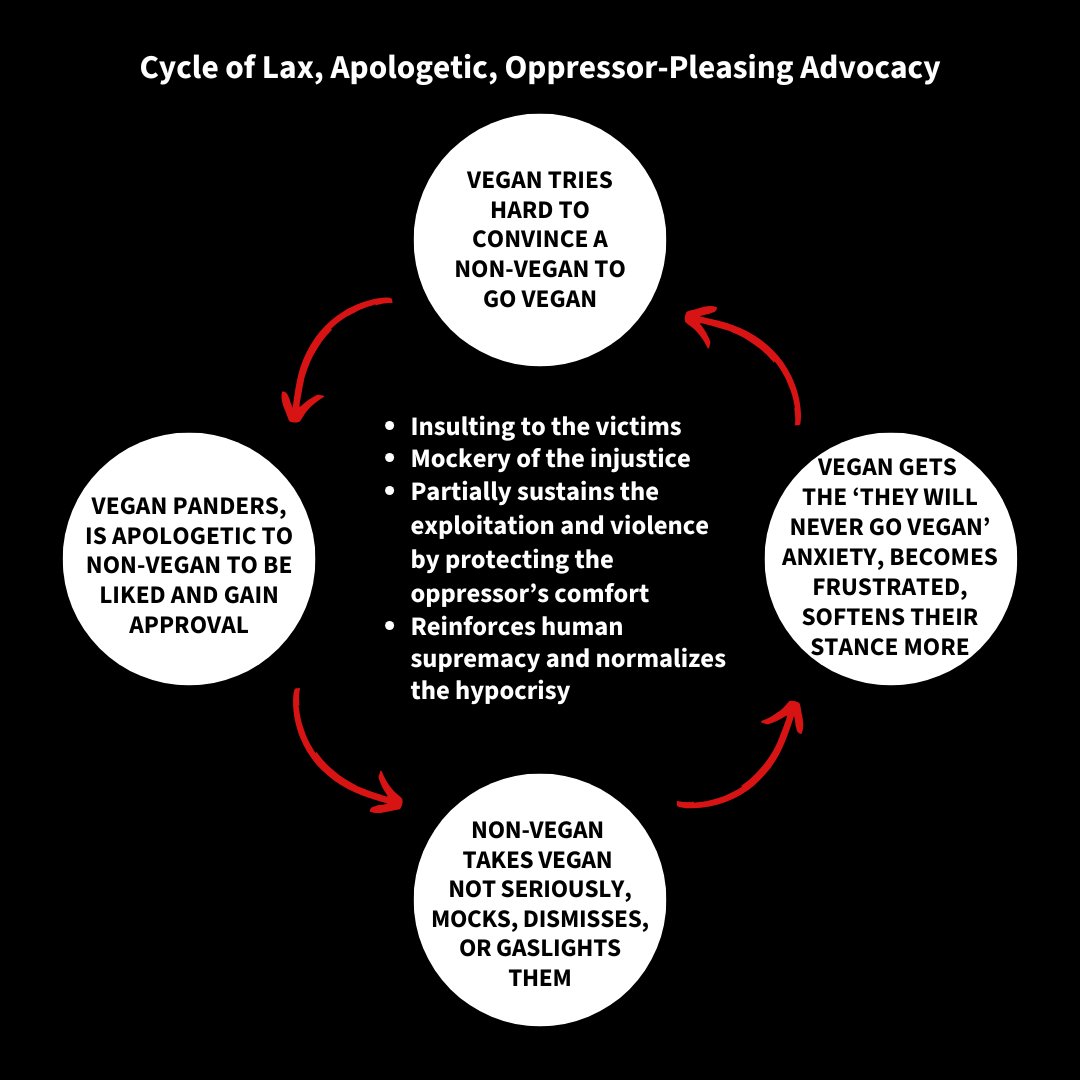
Why would you ever speak up for the other animals with this lax approach, which is insulting to them, and call it vegan advocacy while calling yourself an animal defender? From the victims’ position, this isn’t compassion – it’s mockery of their situation. Why do you treat the exploitation and violence done to them as something that deserves patience, comfort, and gradualism? From where they stand, your softness is complete betrayal.
And if you think one cannot compare human rape with the animal holocaust, then you’re still seeing this from a human‑centric, supremacist perspective rather than from the victims’ perspective – and that mindset also fuels the normalization of exploitation and violence. All injustice must be viewed only 100% from the victims’ standpoint. The point of the comparison is not to equate victims based on species, but to expose the moral double standard – the hypocrisy – which excuses exploitation of and violence against non‑human animals simply because they are not human. Veganism is the ethical principle that humans must live without exploiting other animals – it focuses only on ending human exploitation and violence toward them. But the underlying moral principle and scope is broader: exploitation, violence, domination, and oppression are wrong regardless of the species of the victim, regardless of whose bodily autonomy is violated. Rejecting that truth is exactly how human‑centrism and supremacy maintain themselves.
The other animals need you to speak with the same moral clarity, urgency, and conviction you would demand if you were the one being exploited.
And here’s the part many vegans often forget, because being blinded by non-vegan gaslighting: Even the strongest words, even the most direct moral truth, are nothing – absolutely nothing – compared to the use and physical violence animals endure. A firm sentence is not equivalent to a knife. A moral confrontation is not equivalent to a bolt gun. A moment of human discomfort is not equivalent to a lifetime of confinement. If you truly want to center the victims, you must stop pretending that “being disliked” is some catastrophic outcome. It’s absolutely trivial compared to having your throat cut.
Also please don’t come with the self‑defeating lines “we live in a non‑vegan world” or “gotta be realistic.” No change in history ever came from people who apologized for the status quo or stayed “realistic.” Malcolm X, Martin Luther King Jr., Nelson Mandela, Rosa Parks, and every other major force for justice refused to bow to “realism.” If they had focused on what was socially acceptable, strategically comfortable, or palatable to the majority, nothing would have changed. Progress was made precisely because they rejected the limits imposed by the oppressor’s worldview.
If you want change, you must know your goal and firmly believe in it. The outcome already exists — a vegan world is coming, nothing can stop it, and your strong conviction and bold, unapologetic, uncompromising activism only accelerates it.
Don’t fall for the human‑centric nonsense that humans run this planet and therefore deserve special treatment and that vegan advocacy – and therefore non-human animals – only have a chance if you stay “realistic” and operate inside that human‑centric framework. That’s the whole gaslight. A mindset built on that framework is exactly what blocks your advocacy. Please drop it. Humans are no god species, they do not own this planet, they have no more privilege to share this land than any other animal, regardless of what they claim.
Doing advocacy at the mercy and on the terms of the oppressor is not advocacy; it’s a desperate attempt to protect your ego and comfort, not liberate the animals. If your desire to feel comfortable with the oppressor, liked and validated by them is stronger than your desire to boldly speak up for other animals, you’re literately shitting on the animals, and non-vegans won’t take you seriously (see vicious cycle above).
Put yourself in the victims’ position every single day, if needed every single hour until you acknowledge this simple issue. Focus your advocacy on open‑minded people – the low‑hanging fruit – instead of banging your head against the wall with the closed‑minded or trolls. We do not need every single human to go vegan right now through advocacy. Social‑change research shows that when roughly 10% of the population adopts a committed moral stance, or when about 3–4% become active for justice (as seen in non‑violent movement studies), the whole system reaches a tipping point and shifts – more than enough to end the exploitation of non-human animals. After that advocacy will most likely continue, but will probably shift as well.
Stop diluting the truth, watering down the vegan message, and cushioning the oppressor. In the eyes of the animals, that weakness costs precious lives. In your language, call things exactly what they are instead of using euphemisms, softened terms, confusing labels such as “carnism,” or disingenuous phrases like “meat is murder” (you know well that accidental roadkill is not murder). Use the term “body parts” instead of meat. Stop saying meat-eater, omnivore or carnist. None of these terms make sense. Peaches and jackfruit also have meat (etymologically defined as substance of food). Instead simply say non-vegan or animal exploiter. The subconscious mind of non‑vegans argues back and reinforces their comfortable stance the moment they hear evasive, watered-down, or confusing language.
At the end of the day, this is super simple! Vegan advocacy is not about being liked, being polite, or being socially comfortable. It is about aligning your voice with the victims who’s voices have been suppressed, i.e. made voiceless, because non-vegans have not been listening. It is about refusing to let social norms dictate moral truth. It is about choosing courage over convenience, clarity over comfort, and justice over popularity.
We must break the cycle where vegans pander, non‑vegans mock, vegans soften, and the victims remain unheard. This loop of apologetic, oppressor‑pleasing advocacy is not compassion. It is complicity disguised as strategy. It protects the perpetrator’s comfort while abandoning the victims’ reality.
If vegans with a lax approach cannot speak with honesty and conviction for those who are silenced, then they are not advocates, they are spectators and, worse, enablers. Non‑human animals deserve far more than that. They deserve defenders who refuse to bend their message to the comfort of the oppressor, defenders who refuse to participate in the cycle that partially keeps the exploitation and violence intact, and they deserve that passive vegans step up to use their voice and be active in the fight for their liberation.
Speak up for non-human animals as if your own life were on the line. This is the only approach, a moral obligation. Anything less is an utter insult to the victims and not acceptable, after all, if you were the victim, you would not accept it either.